
August 19, 2026
Fatigue Is a Readiness Variable. Most Systems Treat It as a Scheduling Leftover.
Research in fire, EMS, and police populations consistently associates fatigue with injury and error. Here is what the evidence says, what it does not say, and where fatigue belongs in a readiness picture.
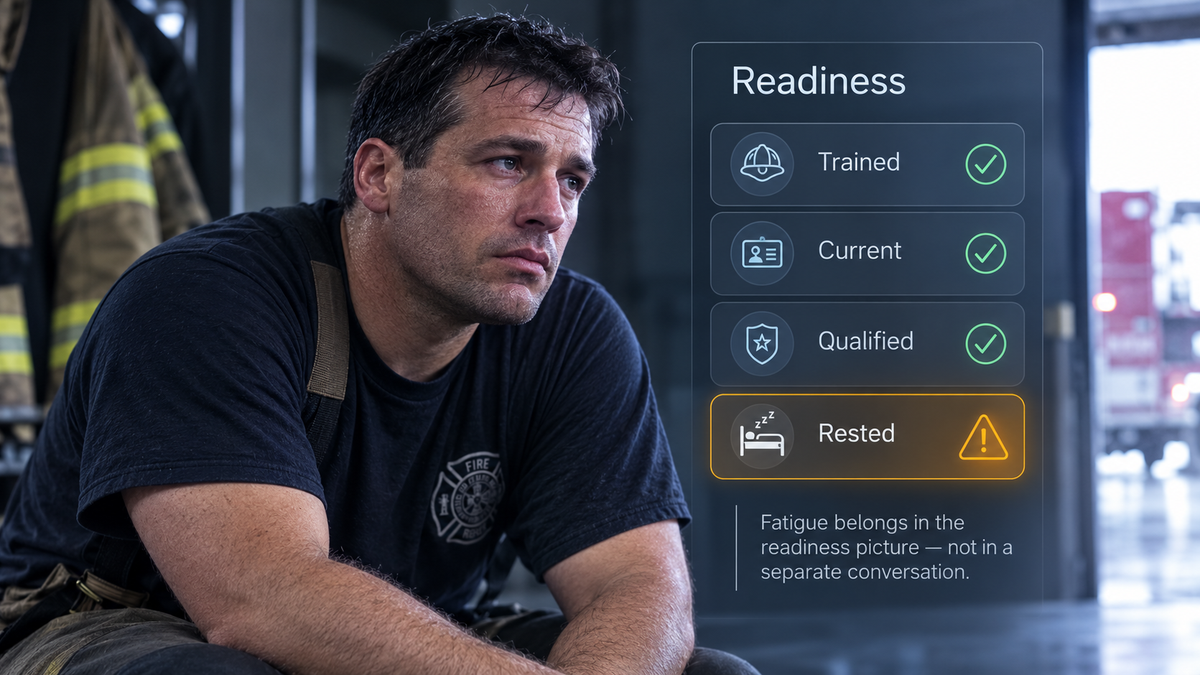
A staffing system can tell you a rig is covered. It usually cannot tell you what the person on it has been through in the previous seventy-two hours.
That gap is not a paperwork problem. It is a readiness problem, and the research on it is more specific than most operational conversations give it credit for.
What the research actually says
The most directly relevant work is a 2023 systematic review of occupation-induced fatigue in emergency first responders (Marvin, Schram, Orr and Canetti, International Journal of Environmental Research and Public Health), covering 43 studies and 6,373 participants — 3,271 firefighters and 3,102 paramedics and EMTs. Fatigue was associated with injury at an odds ratio of 2.13 (95% CI 1.54–2.96). Shifts of 12 hours or more were associated with adverse events at an odds ratio of 3.01, and working 40 or more hours a week with safety-compromising behaviour at an odds ratio of 5.90.
In EMS specifically, Patterson and colleagues (2012, Prehospital Emergency Care) surveyed 511 EMS workers across 30 US agencies, nearly half of whom most commonly worked 24-hour shifts. Fifty-five percent were classified as fatigued. After adjustment, fatigued respondents had roughly twice the odds of injury and of reporting a medical error or adverse event.
In the fire service, Barger and colleagues (2015, Journal of Clinical Sleep Medicine) screened 6,933 career firefighters across 66 departments. Just over 37 percent screened positive for at least one sleep disorder, and a positive screen was associated with double the adjusted odds of a motor vehicle crash.
The schedule itself carries signal. Folkard and Lombardi's risk index (2004) found incident risk roughly 30 percent higher on night shifts than morning shifts and about 27 percent higher on 12-hour shifts than 8-hour shifts. A later meta-analysis (Fischer et al., 2017) put night-versus-morning injury risk at a relative risk of 1.36. NIOSH's 2022 scoping review of working hours and sleep in the public safety sector notes that roughly half of US protective-service workers are on nonstandard schedules.
What the research does not say
It does not say fatigue caused any particular injury. Nearly all of this evidence is associational — cross-sectional surveys, cohort studies, and claims data. Odds ratios describe populations, not the person walking into your station at 0700.
It also does not support prediction. Nothing in this literature lets a system tell a chief that a specific responder will make a specific error today. Anyone selling that is selling ahead of the evidence.
And it does not make fatigue the only variable. Credential currency, role fit, recent training, and call volume all sit in the same picture. Fatigue is one input among several that leadership judgment has to weigh.
Where it belongs
The practical argument is narrower and, we think, harder to dismiss: if fatigue is associated with injury and error at this magnitude in this population, it belongs in the readiness picture rather than in a separate wellness conversation that happens once a year.
Most agencies already hold the raw material. Hours worked, shift patterns, holdover and callback history, and time between assignments all exist somewhere — usually in the scheduling system, which was designed to answer coverage questions, not readiness questions. The information is present and unavailable at the same time.
What a leader can reasonably ask for is visibility: which patterns in the schedule look like the ones the research keeps flagging, and where they are concentrating. Not a score that decides for them. An input that arrives before the shift instead of after the incident.
What this means for what we are building
Parallax ORP is being built around a broader definition of readiness than coverage — trained, current, rested, qualified. On fatigue specifically, the goal is to help leaders see fatigue-related risk factors alongside credentials and role fit. It does not predict fatigue, and it does not prevent injury or burnout. It is not a clinical tool and it does not replace leadership judgment, occupational health programs, or a labor agreement.
If you are a chief or EMS director working on this, we would genuinely like to hear how you are handling it today. Visit www.parallaxorp.com to request more information.
Sources
Marvin G, Schram B, Orr R, Canetti EFD (2023), IJERPH 20(22):7055. Patterson PD et al. (2012), Prehospital Emergency Care 16(1):86–97. Barger LK et al. (2015), Journal of Clinical Sleep Medicine 11(3):233–240. Folkard S, Lombardi DA (2004), Chronobiology International 21(6):1063–1072. Fischer D et al. (2017), Chronobiology International 34(10):1423–1438. Allison P et al. (2022), American Journal of Industrial Medicine 65(11):878–897.
Related posts
September 16, 2026
The roster shows who is on. It rarely shows who is already on overtime.
Coverage answers whether the hole is filled. It almost never answers whether the person filling it is already into forced overtime. Those are different readiness facts. Most boards treat them as one.
August 26, 2026
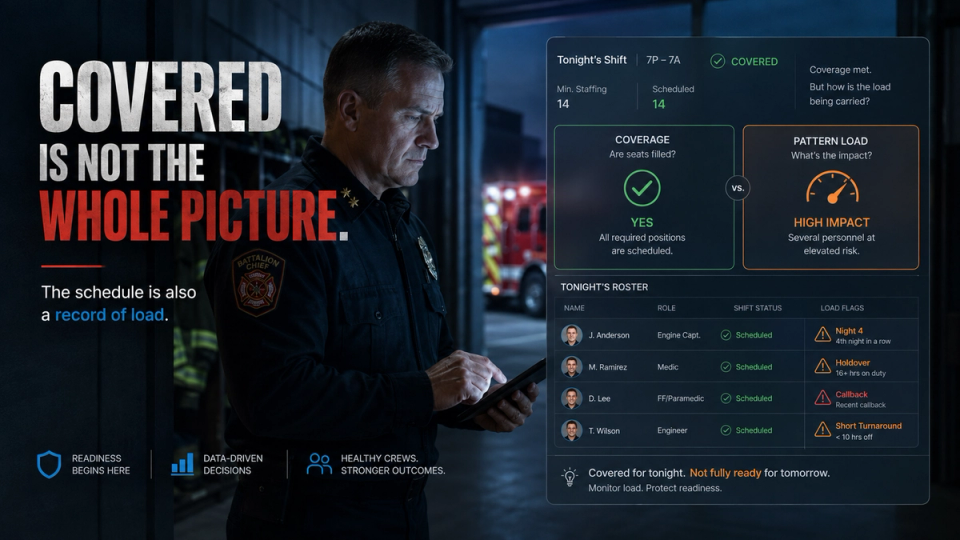
The roster says the shift is filled. It does not say who is on night four.
Two people can be equally qualified, equally current, and still not carry the same readiness profile — because of where they sit in the rotation. The research on that is specific. Almost no roster treats it as a readiness fact.