
August 26, 2026
The roster says the shift is filled. It does not say who is on night four.
Two people can be equally qualified, equally current, and still not carry the same readiness profile — because of where they sit in the rotation. The research on that is specific. Almost no roster treats it as a readiness fact.
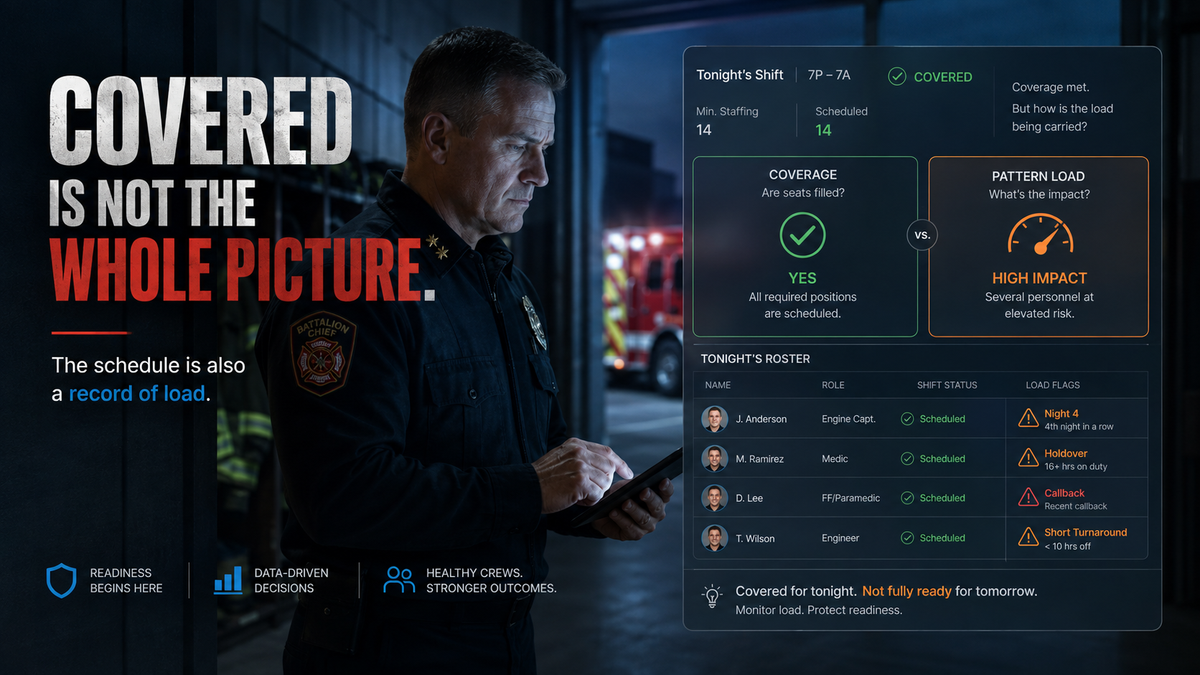
Ask a chief if tonight’s shift is covered and you will get a yes or a no. Ask whether the people on it are on their first night or their fourth, and most systems go quiet.
Those are different questions. The research treats them that way. Most software does not.
What the schedule itself carries
Folkard and Lombardi’s 2004 risk index estimated incident risk about 30% higher on night shifts than morning shifts. Across successive nights, that risk kept climbing — roughly 36% higher by the fourth night in a row. Twelve-hour shifts sat about 27% above eight-hour shifts, with more of that load in the last hour.
A 2017 meta-analysis of 29 high-quality studies (Fischer, Lombardi, Folkard, Willetts, Christiani; Chronobiology International) put night-versus-morning injury risk at a relative risk of 1.36 (95% CI 1.15–1.60). Same direction. Tighter estimate.
And in a NIOSH-coauthored study of 419 Buffalo, NY police officers with 16 years of payroll history (Violanti et al., 2013), the rate of long-term on-duty injury leave — 90 days or more — was 3.12 times higher for night shift than day shift (95% CI 1.35–7.21). That is a police finding, in a police population. It is not a firefighter finding. The direction still belongs in the conversation.
What this does not say
It does not say the night shift caused any particular injury. These are associations. Relative risks describe populations, not the person standing in your bay at 0700.
It does not let a system predict who will get hurt tonight. Anyone selling that is ahead of the evidence.
It does not make shift pattern the only readiness variable. Credentials, role fit, recent training, and call volume all sit in the same picture. Pattern is one input leadership judgment has to weigh — which is hard to do if it is invisible.
The operational gap
The roster answers coverage: is the hole filled. It almost never answers pattern: is this person on night four, coming off a holdover, or first tour back after 48 hours down.
Two equally qualified, equally current responders are not interchangeable if only one of those facts is on the screen. The battalion chief filling a hole at 0400 will use whatever is closest at hand. If the pattern is in a different system — or only in someone’s head — it will not be part of the decision.
Last month I wrote about fatigue as a readiness variable (Fatigue Is a Readiness Variable). This is the narrower claim underneath it: the schedule is not just a staffing document. It is also a record of load. If you cannot see the load, you are staffing from half the picture.
What a leader can actually ask for
You do not need a new platform to start. You do need a way to see, at the moment of the decision:
- Who is on a night stretch, and which night of it
- Who is coming off overtime, callback, or a short turnaround
- Whether “covered” and “the pattern looks like the ones the research keeps flagging” are being answered in the same place
Not a score that decides for you. An input that arrives before the shift.
Parallax ORP is being built around a broader definition of readiness than coverage. On this specifically, the goal is to make pattern visible enough to be part of the decision — not to predict fatigue, and not to override anyone’s judgment.
If you are filling a hole tonight, do you have any way to see where each candidate sits in their own rotation?
Sources
Folkard S, Lombardi DA (2004), Chronobiology International 21(6):1063–1072. Fischer D, Lombardi DA, Folkard S, Willetts J, Christiani DC (2017), Chronobiology International 34(10):1423–1438. Violanti JM et al. (2013), Scandinavian Journal of Work, Environment & Health 39(4):361–368. Related: Marvin et al. (2023); Patterson et al. (2012); Barger et al. (2015).
Related posts
September 18, 2026
The Build Sheet #3: A change without an author is a record you cannot defend
Status without a reason. Date without a source. Next gap in the same record: a change with no author. Six months later you know something moved. You cannot say who moved it, or whether anyone should still trust it.
September 16, 2026
The roster shows who is on. It rarely shows who is already on overtime.
Coverage answers whether the hole is filled. It almost never answers whether the person filling it is already into forced overtime. Those are different readiness facts. Most boards treat them as one.
September 4, 2026
The Build Sheet #2: A date without a source is a fact you cannot trust later
Last week: a status without a reason. Next gap in the same record: a date with no source. March 31 in a cell is not the same fact as March 31 from the Registry, the state office, or someone’s memory.