

Aaron Engelsrud
Founder
Aaron Engelsrud is the founder of Parallax ORP, an operational readiness platform built for fire, EMS, and public safety agencies. Parallax ORP answers the question every chief has to be able to answer at any moment: are we ready to respond right now? — unifying personnel credentialing, workforce scheduling, and apparatus/equipment status into a single readiness signal. Aaron brings nearly 30 years of emergency services domain experience to Parallax ORP, and that operational background shapes every decision in the platform — from its NFPA ERRS-aligned data architecture to its strict separation between tenant administration and command authority. He built Parallax ORP API-first and multi-tenant from day one, with a rules-first approach to AI: technology should support the judgment of chiefs and battalion commanders, not replace it. As a solo founder, Aaron oversees product, engineering, and go-to-market — working directly with fire chiefs and battalion chiefs through white-glove, demo-driven discovery to make sure the platform is built around how departments actually operate, not how software vendors assume they do.
September 18, 2026
The Build Sheet #3: A change without an author is a record you cannot defend
Status without a reason. Date without a source. Next gap in the same record: a change with no author. Six months later you know something moved. You cannot say who moved it, or whether anyone should still trust it.
September 16, 2026
The roster shows who is on. It rarely shows who is already on overtime.
Coverage answers whether the hole is filled. It almost never answers whether the person filling it is already into forced overtime. Those are different readiness facts. Most boards treat them as one.
September 4, 2026
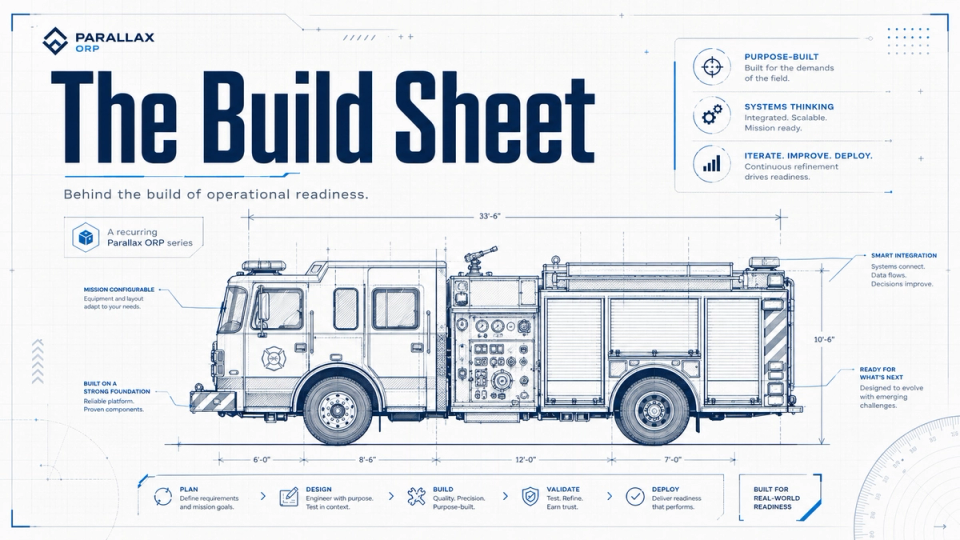
The Build Sheet #2: A date without a source is a fact you cannot trust later
Last week: a status without a reason. Next gap in the same record: a date with no source. March 31 in a cell is not the same fact as March 31 from the Registry, the state office, or someone’s memory.
September 2, 2026
The roster can name the person in the seat. It often cannot say if they are still current for it.
A filled line answers coverage. It does not answer whether the person in that seat is still current for the assignment. The standards already treat those as different facts. Most rosters do not.
August 28, 2026
The Build Sheet #1: A status without a reason is a fact you can't reason from
When a person left active status, the system recorded that it happened. It did not record why. Retired, transferred, injury, cert lapse, and light duty all looked the same — and each means something different for the roster you inherit.
August 26, 2026
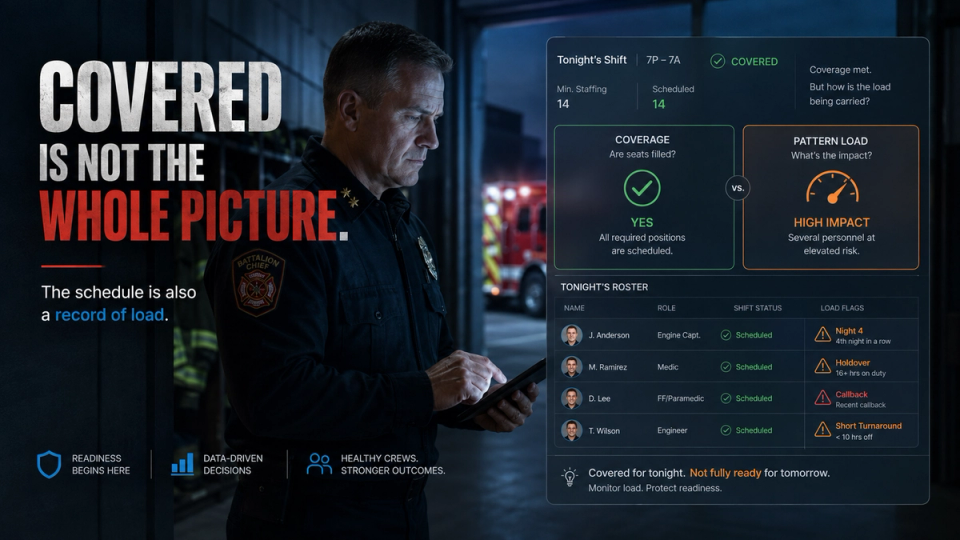
The roster says the shift is filled. It does not say who is on night four.
Two people can be equally qualified, equally current, and still not carry the same readiness profile — because of where they sit in the rotation. The research on that is specific. Almost no roster treats it as a readiness fact.
August 19, 2026
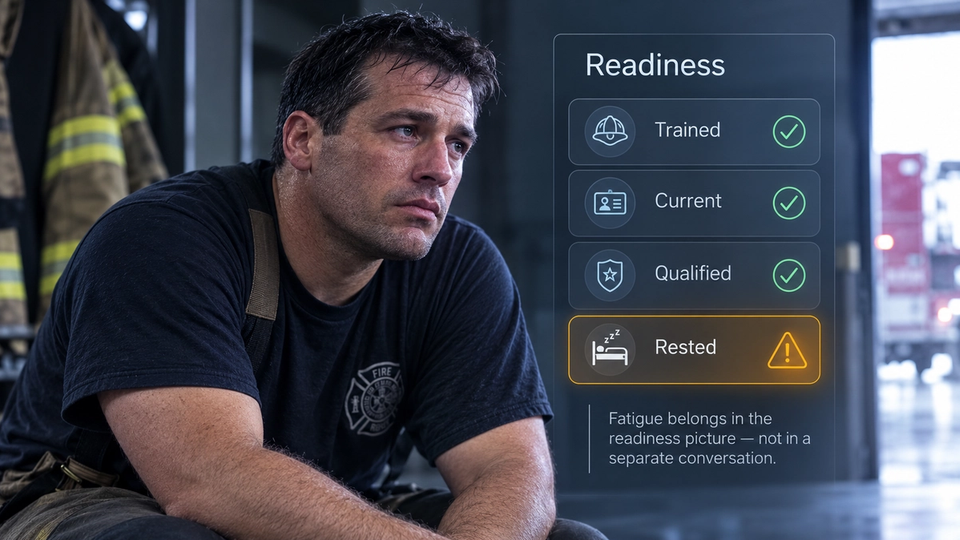
Fatigue Is a Readiness Variable. Most Systems Treat It as a Scheduling Leftover.
Research in fire, EMS, and police populations consistently associates fatigue with injury and error. Here is what the evidence says, what it does not say, and where fatigue belongs in a readiness picture.
August 7, 2026
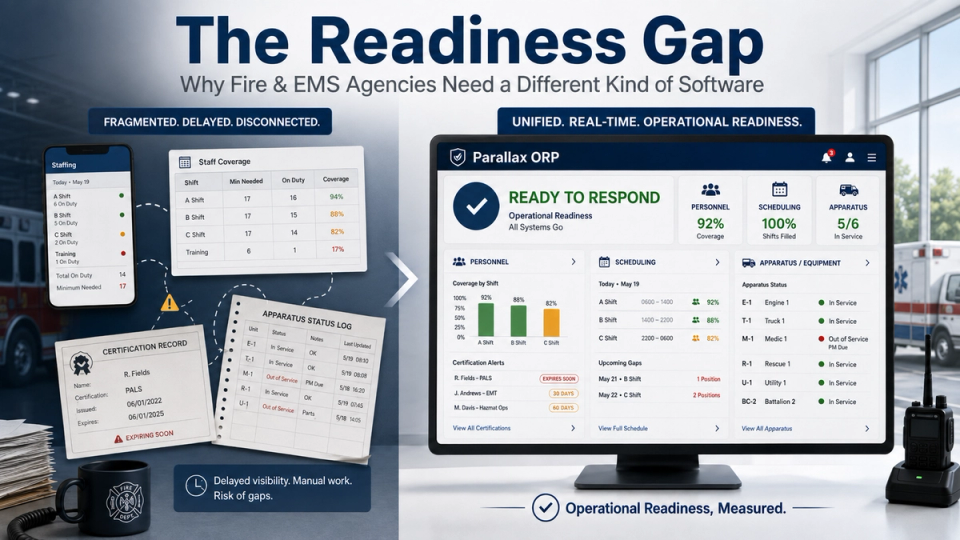
The Readiness Gap: Why Fire and EMS Agencies Need a Different Kind of Software
Fire and EMS agencies are being asked to do more with a shrinking workforce, equipment that has to be provably compliant, and budgets that don't stretch to three specialized systems that don't talk to each other. Most software solves a third of the readiness question — staffing, or equipment, or credentials — and leaves the rest to spreadsheets and memory. Parallax ORP starts from the question that actually matters and builds backward from there.