
August 7, 2026
The Readiness Gap: Why Fire and EMS Agencies Need a Different Kind of Software
Fire and EMS agencies are being asked to do more with a shrinking workforce, equipment that has to be provably compliant, and budgets that don't stretch to three specialized systems that don't talk to each other. Most software solves a third of the readiness question — staffing, or equipment, or credentials — and leaves the rest to spreadsheets and memory. Parallax ORP starts from the question that actually matters and builds backward from there.
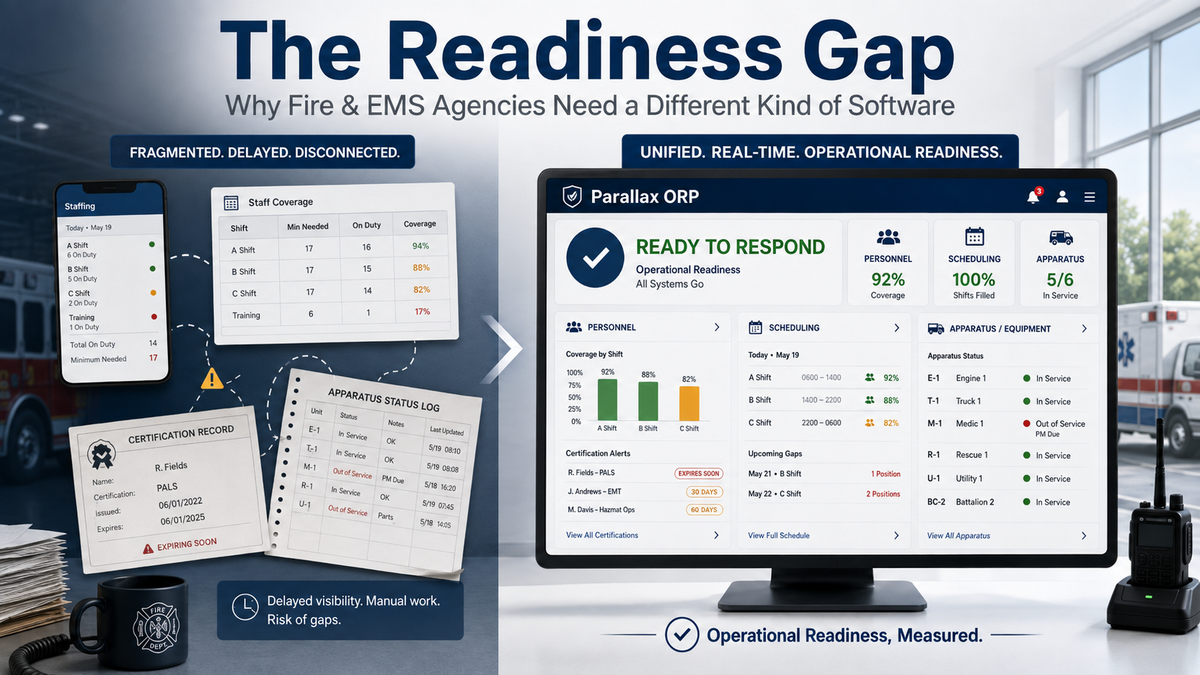
Ask a fire chief or EMS director a simple question — "Are we ready to respond right now?" — and watch what happens next. Someone checks a staffing app for who's on shift. Someone else opens a spreadsheet to see which apparatus are in service. A third person scrolls through a shared drive looking for a medic's current ACLS card, because the certification tracker hasn't been updated since spring. Fifteen minutes later, there's an answer. It's probably right. But it took fifteen minutes to find out something that should be visible in fifteen seconds.
That gap — between the question every public safety leader needs answered constantly and the fragmented systems they have to answer it — is the problem Parallax ORP exists to close.
An industry running short-staffed and running hot
The staffing side of this problem isn't a rounding error. It's structural.
Volunteer firefighting, which still covers roughly a third of the U.S. population and makes up the majority of the nation's fire departments, has been shrinking for four decades. National volunteer numbers have fallen from a peak of around 1.1 million in the 1980s to roughly 677,000, the lowest level in decades, even as call volumes have tripled over the same stretch. New York State alone has watched its volunteer ranks fall by an estimated 30 to 40 percent since 2020. Fire chiefs in small departments describe the same pattern: a shrinking pool of people answering more calls, more often, with less time to recover between them.
EMS is under comparable strain, with the added weight of chronic understaffing on top of attrition. Recent industry surveys put burnout as the number one concern in the field — cited as a critical issue by roughly three-quarters of providers — and only about six in ten agencies report having enough staff to reliably answer 911 calls. More than a third of EMS providers say they're considering leaving the profession within five years, and national studies show burnout rates nearly doubling over the past decade among EMS clinicians. Turnover in this sector isn't a talent-pipeline inconvenience; it's an operational risk that shows up as missed calls, mandatory overtime, and crews running on fumes.
None of this is solved by software. But all of it makes one thing non-negotiable: agencies operating with less slack than ever cannot afford to lose visibility into the people, apparatus, and schedules they do have. When margins shrink, the cost of not knowing your real status — who's qualified, who's available, what's in service — goes up sharply.
The apparatus and equipment side tells the same story
Readiness isn't just a staffing question. NFPA 1911 requires systematic inspection and maintenance programs for fire apparatus, and NFPA schedules govern everything from SCBA hydrostatic testing to ground ladder and pump certification. Yet industry analysts and vendors serving this space consistently point to the same failure mode: many departments still run these programs on paper logs and shared spreadsheets, where a piece of critical safety equipment's compliance status lives in a single cell that anyone could overwrite, with no audit trail behind it.
That's not a hypothetical compliance risk — it's an audit finding waiting to happen, and worse, it's an operational blind spot. If an engine's pump test is overdue or a rescue tool failed its last inspection, that information needs to surface automatically to whoever is deciding what apparatus to send on the next call. In most agencies today, it doesn't. It sits in a maintenance shop's system, or a chief's inbox, or nowhere formal at all — disconnected from the staffing system, disconnected from the personnel system, disconnected from the moment someone actually needs to know.
Why three separate answers aren't good enough
Here's the pattern across nearly every public safety agency we've talked to: personnel records live in one system (often a spreadsheet or a general-purpose HR tool never built for certifications and credentials). Scheduling lives in another — built for shift assignment, not for surfacing fatigue risk or overtime exposure before it becomes a liability. Apparatus and equipment status lives in a third, frequently a maintenance-shop tool that field commanders don't have real-time access to.
Each of those systems might individually do its narrow job well. What none of them do is answer the actual question a chief, a battalion commander, or a duty officer needs answered under time pressure: right now, today, for this call — are we ready? That answer requires personnel, scheduling, and apparatus data to talk to each other, in real time, without someone manually reconciling three logins and two spreadsheets during an emergency.
This is the gap Parallax ORP is built to close — not by being a better staffing app, or a better maintenance tracker, or a better credential database in isolation, but by treating readiness as one connected question across all three domains at once.
What Parallax ORP actually does
Parallax ORP is an Operational Readiness Platform built specifically for fire, EMS, and public safety agencies, organized around three co-equal pillars:
Personnel. A single, authoritative record of who's credentialed, certified, and qualified for what — not a spreadsheet that's accurate as of whenever someone last remembered to update it, but a live system where a certification's status is always current and always visible to the people who need to see it.
Scheduling and workforce. Visibility into who's on shift, who's available, and where fatigue and overtime exposure are building before they become a safety problem or a liability — built for the reality of combination departments juggling career staff, volunteers, and mutual aid.
Apparatus and equipment. Real-time status on what's in service, what's overdue for inspection, and what's out of commission — connected to the same system tracking people and schedules, so a maintenance flag on an engine and a credential gap on a crew member show up in the same place, not three different ones.
Every one of those pillars is built with two audiences in mind from day one: a command-level view for chiefs and administrators who need the organizational picture, and a field-level "my readiness" view for the responders whose certifications, assignments, and equipment those decisions actually affect. Neither view is an afterthought bolted onto the other.
Built for how public safety actually makes decisions
A few principles run underneath all of this, because agencies that answer to elected boards, state credentialing bodies, and federal grant auditors don't have room for a system that guesses.
Authorization follows the org chart the way it actually works in the field — a battalion chief can see what their battalion needs to see, without that access model breaking down the moment someone acts outside their home unit on a mutual-aid call. A tenant administrator managing their department's data is a distinct role from platform-level administration — the same hard boundary any agency would expect between "who runs our department's account" and "who runs the software itself." And where AI has a role — flagging a credential about to lapse, surfacing a fatigue pattern before it becomes an incident report — it works in service of rules and standards that are already defensible, not as a black box making judgment calls a chief would have to explain to a board.
The bottom line
Fire and EMS agencies are being asked to do more with a workforce that's shrinking, on equipment that has to be provably compliant, on budgets that don't stretch to three separate specialized systems that don't talk to each other. The tools built to help them are, too often, part of the problem — solving one-third of the readiness question while leaving the other two-thirds to memory, spreadsheets, and hope.
Parallax ORP starts from the question that actually matters — are we ready to respond right now? — and builds the platform backward from there, across personnel, scheduling, and equipment, for the command staff making the call and the responders living with it.
Sources: National Fire Protection Association (NFPA) U.S. Fire Department Profile; National Volunteer Fire Council Fire Service Fact Sheet; Fitch & Associates 2025 EMS Trend Survey via EMS1; National Registry of EMTs workforce research; NFPA 1911 Standard for Fire Apparatus Inspection, Maintenance, Testing, and Retirement.
Related posts
September 16, 2026
The roster shows who is on. It rarely shows who is already on overtime.
Coverage answers whether the hole is filled. It almost never answers whether the person filling it is already into forced overtime. Those are different readiness facts. Most boards treat them as one.
September 2, 2026
The roster can name the person in the seat. It often cannot say if they are still current for it.
A filled line answers coverage. It does not answer whether the person in that seat is still current for the assignment. The standards already treat those as different facts. Most rosters do not.