
September 2, 2026
The roster can name the person in the seat. It often cannot say if they are still current for it.
A filled line answers coverage. It does not answer whether the person in that seat is still current for the assignment. The standards already treat those as different facts. Most rosters do not.
Ask a chief if the medic unit is covered and you will get a yes or a no. Ask whether the person in the ALS seat is still current for that assignment (National Registry, state license, ACLS, driver/operator) and a lot of systems go quiet.
Those are different questions. The standards already treat them that way. Most rosters do not.
What the standard and the credential record actually say
NFPA 1710 (2020) does not treat a filled company as a headcount only. It requires the department to identify minimum company staffing so a sufficient number of members are assigned, on duty, and available to respond with each company. Engine companies remain a minimum of four on-duty members. The 2020 revision also required response personnel to be trained in their assigned positions under NFPA 1500.
Assigned. On duty. Available. Trained for the assignment. Those are separate facts. A name in a seat is only the first one.
On the EMS side, currency is not a one-time hire fact. Nationally Registered EMTs have to renew every two years, by continuing education or by examination. EMT recertification under the National Continued Competency Program is forty credits in a two-year cycle. State license renewal runs on its own clock. The National Registry is explicit that you have to check both.
That two-year cycle is also how researchers even see the workforce. Gage, Powell, Cash, and Panchal (2023, Prehospital Emergency Care) used ten years of National Registry initial certifications as the entry signal: average growth of 4.3 percent a year, and 474,622 nationally certified EMTs, AEMTs, and paramedics as of 2022. A year later, Gage and colleagues (2024, Prehospital Emergency Care) surveyed people after they recertified: 29,671 EMTs and paramedics, 25.9 percent response rate. That is the point. The population is defined at the moment the credential is being renewed. The roster treats the name as durable. The credential is not.
What this does not say
It does not say a lapsed card caused any particular bad call. I am not citing an outcome study that does not exist.
It does not let a system decide who rides. Currency is an input. The officer still makes the assignment.
It does not make credential the only readiness variable. Shift pattern, fatigue, role fit, and call volume sit in the same picture. Last week I wrote that two equally qualified people are not interchangeable if one is on night four. This is the other half of that sentence: two people on the same line are not interchangeable if only one is still current for the seat.
It also does not say every agency is failing a standard. NFPA 1710 is a standard, not a statute, unless an authority having jurisdiction adopts it. The operational claim is narrower: the standard already separates “on the line” from “current for the assignment.” Most of the screens used to fill a hole do not.
The operational gap
The roster answers coverage: is the hole filled. It almost never answers currency: is this person still allowed to hold that assignment today.
Driver/operator, officer, ALS, precepting, instructor. Those are different facts. National Registry and the state card can expire on different days. A photocopy of a card from 2019 and a date somebody typed into a cell during a busy week look the same on the board. They are not the same when you have to stand behind the assignment.
The person filling a hole at 0400 will use whatever is on the screen. If currency lives in a filing cabinet, a shared drive, or the training officer’s head, it is not part of the decision.
What a leader can actually ask for
You do not need a new system to start. You do need a way to see, at the moment of the decision:
- Who is assigned to the seat, and who is still current for that assignment
- Which credentials expire inside the current cycle, and on which clock (national, state, or department)
- Whether “covered” and “current for the assignment” are being answered in the same place
Not a score that decides who rides. An input that arrives before the tones.
Parallax ORP is being built around a broader definition of readiness than coverage: trained, current, rested, qualified. On this specifically, the goal is to make currency visible enough to weigh. It does not replace a medical director, a training officer, or a labor agreement.
When you look at tonight’s line, can you see which names are still current for the seat they are sitting in?
Sources
NFPA 1710, Standard for the Organization and Deployment of Fire Suppression Operations, Emergency Medical Operations, and Special Operations to the Public by Career Fire Departments (2020), including 5.2.2.2.1 and 5.2.3; NFPA 1710 fact sheet (June 2020). NFPA 1500, Standard on Fire Department Occupational Safety, Health, and Wellness Program. National Registry of Emergency Medical Technicians, EMT Recertification (two-year cycle; NCCP 40 credits). Gage CB, Powell JR, Cash RE, Panchal AR (2023), Prehospital Emergency Care, doi:10.1080/10903127.2023.2249566. Gage CB, Cooke CB, Powell JR, et al. (2024), Prehospital Emergency Care 29(7):1008–1014, doi:10.1080/10903127.2024.2436047. Related live posts: https://www.parallaxorp.com/blog/the-roster-does-not-show-night-four and https://www.parallaxorp.com/blog/fatigue-is-a-readiness-variable
Related posts
September 4, 2026
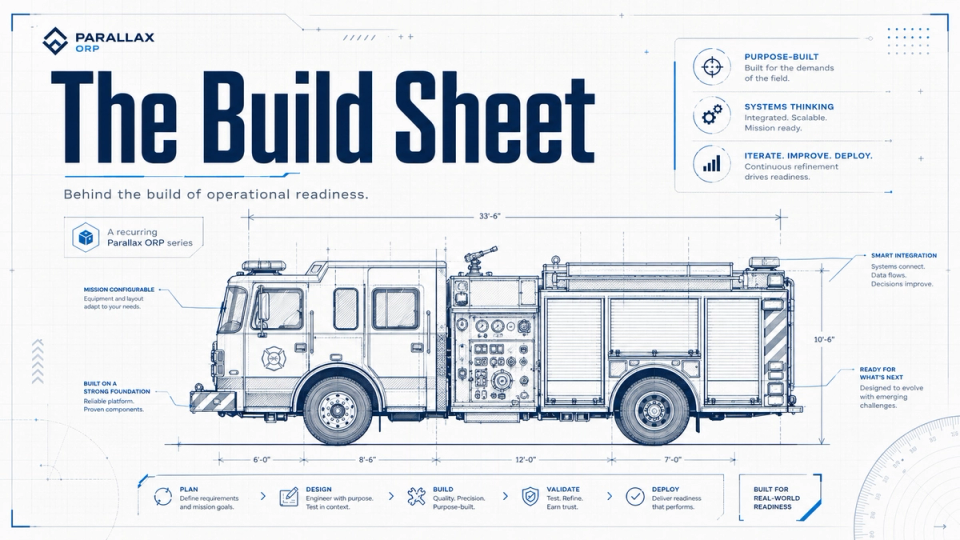
The Build Sheet #2: A date without a source is a fact you cannot trust later
Last week: a status without a reason. Next gap in the same record: a date with no source. March 31 in a cell is not the same fact as March 31 from the Registry, the state office, or someone’s memory.
August 28, 2026
The Build Sheet #1: A status without a reason is a fact you can't reason from
When a person left active status, the system recorded that it happened. It did not record why. Retired, transferred, injury, cert lapse, and light duty all looked the same — and each means something different for the roster you inherit.
August 26, 2026
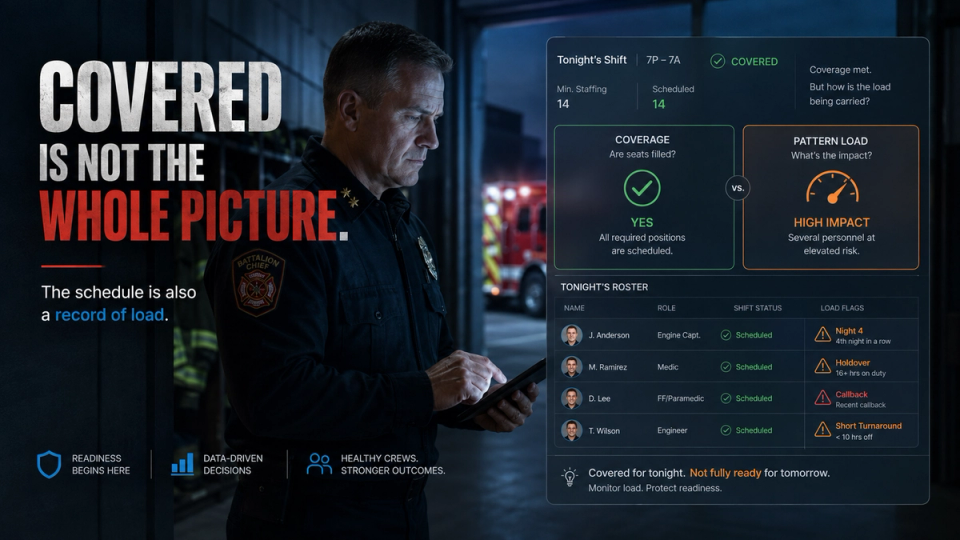
The roster says the shift is filled. It does not say who is on night four.
Two people can be equally qualified, equally current, and still not carry the same readiness profile — because of where they sit in the rotation. The research on that is specific. Almost no roster treats it as a readiness fact.